
Your Trusted RFID Product Manufacturer

Choosing the Right RFID Card Material for Access Control Programs
August 12, 2025
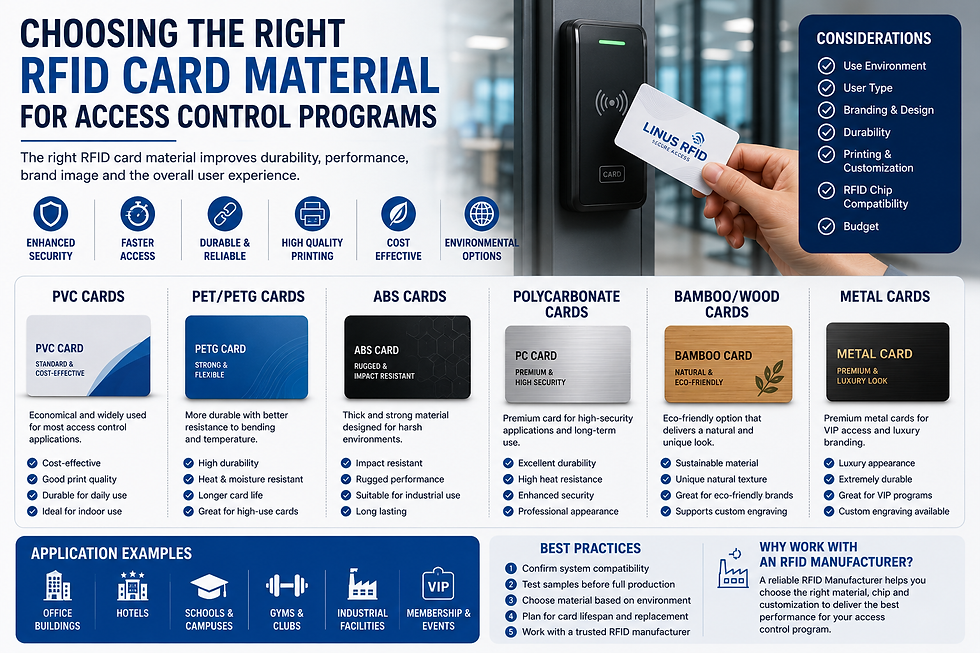
RFID cards are one of the most widely used RFID Products for access control programs. From office buildings and hotels to schools, gyms, apartments, healthcare facilities, and membership clubs, RFID cards help organizations manage secure entry, identify users, and improve daily operations.
However, choosing the right RFID card is not only about selecting the correct chip. The card material also matters. The material affects durability, appearance, cost, print quality, environmental performance, and the overall user experience. For businesses planning an access control program, selecting the right RFID Card material can help improve performance, reduce replacement costs, and create a more professional credential.
Why RFID Card Material Matters
An RFID Card usually contains an RFID chip and antenna embedded inside or attached to the card body. While the chip controls system compatibility, the card material affects how the card looks, feels, and performs in real-world use.
The right material can help with:
Daily durability
Brand presentation
Printing quality
Water resistance
Heat resistance
Flexibility
Cost control
Sustainability goals
Long-term user experience
For access control programs, cards are often used every day. Employees, members, tenants, guests, and students may carry the card in a wallet, badge holder, lanyard, or pocket. A poorly selected material can lead to cracking, bending, fading, or early replacement.
Common RFID Card Materials
Different RFID card materials are available depending on the application, budget, and branding needs. The most common options include PVC, PET, PETG, ABS, PC, bamboo, wood, and metal.
Each material has its own advantages.
PVC RFID Cards
PVC is one of the most common materials for RFID access cards. It is economical, easy to print, and widely used for high-volume card programs.
PVC RFID cards are commonly used for:
Office access cards
Hotel key cards
School ID cards
Membership cards
Gym access cards
Visitor cards
Event credentials
Benefits of PVC RFID Cards
PVC cards are popular because they offer a good balance of cost, durability, and print quality. They are suitable for most standard indoor access control applications.
Key benefits include:
Cost-effective for bulk orders
Good printing surface
Standard CR80 card size availability
Compatible with many RFID chip options
Suitable for full-color printing
Good for short-term and medium-term use
PVC RFID cards are a practical choice for businesses that need reliable access control cards at a competitive price.
PET and PETG RFID Cards
PET and PETG are more durable card materials compared with standard PVC. They are often selected when the card needs better resistance to bending, cracking, heat, or environmental stress.
PET and PETG RFID cards are useful for:
Long-term employee cards
Campus access cards
Industrial facilities
Outdoor access programs
High-use membership cards
Transportation or facility cards
Benefits of PET and PETG Cards
PET and PETG cards offer improved durability while still allowing strong printing quality.
Benefits include:
Better heat resistance than PVC
Improved flexibility
Longer service life
Better resistance to cracking
Suitable for frequent use
Good print performance
For access control programs where cards are expected to last longer, PET or PETG may be a better choice than standard PVC.
ABS RFID Cards
ABS is a strong plastic material often used for durable RFID cards, keyfobs, and access credentials. ABS RFID cards can be useful when the card needs to handle rougher daily use.
ABS RFID cards may be used for:
Industrial access control
Warehouse employee IDs
Parking access
Facility management
Staff credentials
Outdoor access environments
Benefits of ABS RFID Cards
ABS provides strong impact resistance and a durable feel.
Benefits include:
Stronger impact resistance
Good durability
Suitable for rugged use
Good option for harsh environments
Works well for thicker card designs
ABS may not always offer the same high-end printing finish as PVC or PETG, but it can be a strong choice for functional and durable access cards.
Polycarbonate RFID Cards
Polycarbonate, often called PC, is a premium card material known for high durability and resistance to heat and wear. It is often used for high-security credentials and long-term ID applications.
Polycarbonate RFID cards may be used for:
Government access cards
High-security facility credentials
Long-term employee IDs
Critical infrastructure access
Premium membership cards
Secure campus credentials
Benefits of Polycarbonate RFID Cards
Polycarbonate cards are strong, durable, and suitable for demanding programs.
Benefits include:
Excellent durability
High heat resistance
Long card life
Premium feel
Good for secure ID programs
Strong resistance to wear
For access control programs where security and long-term durability are priorities, polycarbonate can be a strong option.
Bamboo and Wood RFID Cards
Bamboo and wood RFID cards are selected when sustainability and natural appearance matter. These cards combine RFID functionality with a unique organic look.
Bamboo or wood RFID cards are often used for:
Eco-friendly hotels
Resorts
Wellness centers
Membership clubs
Luxury spas
Sustainable brands
Boutique access programs
Benefits of Bamboo and Wood RFID Cards
Natural material RFID cards help create a distinctive customer experience.
Benefits include:
Natural appearance
Premium brand image
Strong eco-friendly impression
Unique texture and grain
Good for hospitality and lifestyle brands
Suitable for laser engraving or custom printing
Because natural materials can vary slightly in texture and color, each card may look slightly different. This can be a benefit for brands that want a more natural and personalized feel.
RFID Metal Cards
RFID metal cards are used when a premium, durable, and exclusive appearance is important. These cards are commonly used for VIP access, luxury memberships, private clubs, high-end hotels, and NFC business cards.
RFID metal cards may be used for:
VIP membership programs
Luxury hotel access
Private club credentials
Executive access cards
Premium event passes
NFC digital business cards
Benefits of RFID Metal Cards
Metal cards create a strong impression and high perceived value.
Benefits include:
Premium appearance
Strong durability
Luxury brand positioning
Excellent for VIP programs
Custom engraving options
Memorable user experience
Because metal can affect RFID performance, RFID metal cards require careful design. It is important to work with an experienced RFID Manufacturer to ensure the card reads properly with the intended system.
How to Choose the Right RFID Card Material
The best RFID card material depends on how and where the card will be used. Before selecting a material, consider the access control environment, expected card life, branding goals, and budget.
Consider the Use Environment
For standard indoor access control, PVC cards are often enough. For outdoor, industrial, or high-use environments, PETG, ABS, or polycarbonate may be better.
Ask:
Will the card be used indoors or outdoors?
Will it be exposed to heat, moisture, or rough handling?
Will users carry it daily?
Does the card need to last for years?
Consider the User Type
Different users may require different card materials.
For example:
Employees may need durable long-term cards.
Hotel guests may need short-term key cards.
VIP members may expect premium cards.
Students may need economical but durable cards.
Industrial workers may need rugged cards.
Matching the card material to the user type helps improve both cost efficiency and satisfaction.
Consider Branding and Appearance
Access cards are often part of a company’s visual identity. A well-designed RFID Card can make a business look more professional.
For premium branding, bamboo, wood, metal, PETG, or polycarbonate may create a stronger impression. For standard employee access, PVC may be more practical and economical.
Consider Printing and Customization
Different materials support different customization methods.
Common options include:
Full-color printing
Spot color printing
Laser engraving
Barcode printing
QR code printing
Serial number printing
UID printing
Signature panel
Magnetic stripe
Hole punching
Matte or glossy finish
PVC and PETG are strong choices for full-color printing. Bamboo, wood, and metal are often selected for engraving or premium design effects.
Consider RFID Chip Compatibility
The card material is important, but chip compatibility is still essential. Access control systems may require specific RFID frequencies and chip types.
Common RFID card technologies include:
LF RFID cards
HF RFID cards
NFC cards
UHF RFID cards
MIFARE-compatible cards
Proximity cards
Custom chip options
Before ordering, confirm the chip type, frequency, memory, security level, and reader compatibility.
Consider Budget and Replacement Cost
PVC cards are usually the most cost-effective for large programs. Premium materials may cost more upfront, but they can improve durability, branding, or user experience.
When comparing costs, consider:
Initial card cost
Expected card life
Replacement rate
Printing cost
Encoding cost
Shipping and packaging
User experience value
A slightly more durable card may reduce replacements over time, while a premium card may support a higher-end brand image.
Recommended RFID Card Materials by Application
Office Access Control
PVC, PETG, or polycarbonate RFID cards are good options depending on expected use life.
Hotel Key Cards
PVC cards are common for standard hotels. Bamboo, wood, or metal cards may be used for boutique or luxury properties.
Gym and Membership Cards
PVC and PETG cards work well for most membership programs. Metal cards can be used for VIP or premium members.
School and Campus Cards
PETG or polycarbonate cards are good for longer-term student ID and access programs.
Industrial Facilities
ABS, PETG, or polycarbonate cards are better for more rugged access environments.
VIP Clubs and Luxury Programs
Metal, bamboo, wood, or premium PETG cards can create a stronger brand impression.
Why Work With an RFID Manufacturer?
Choosing the right RFID card material can be challenging because the card must match both the access control system and the physical use environment. Working with an experienced RFID Manufacturer helps ensure the final RFID Product performs correctly and meets branding expectations.
An RFID Manufacturer can help with:
Material selection
RFID chip recommendation
Card structure design
Printing method selection
Laser engraving options
RFID encoding
UID or serial number printing
Barcode and QR code printing
Sample testing
Bulk production
Packaging support
For access control programs, testing samples before full production is strongly recommended.
Best Practices Before Ordering RFID Cards
Before placing a bulk RFID card order, organizations should:
Confirm the access control system chip requirement.
Choose the card material based on use environment.
Test samples with the actual RFID readers.
Confirm card size, thickness, and finish.
Review artwork carefully before production.
Decide whether encoding is required.
Add printed backup identifiers if needed.
Confirm hole-punching or badge holder requirements.
Choose packaging based on distribution needs.
Work with an experienced RFID Manufacturer.
Conclusion
Choosing the right RFID card material is an important step in building a successful access control program. PVC cards offer an economical and practical option for many standard applications, while PETG, ABS, and polycarbonate provide stronger durability for higher-use environments. Bamboo, wood, and metal RFID cards offer premium branding options for hospitality, membership, and VIP access programs.
The best RFID Card depends on your access control system, budget, environment, branding goals, and expected card life. By working with a reliable RFID Manufacturer, organizations can choose the right RFID Product for secure, durable, and professional access control.
Linus RFID provides custom RFID cards, RFID metal cards, RFID bamboo cards, RFID labels, NFC cards, wristbands, and other RFID products for access control, hospitality, membership, events, healthcare, and identification applications. With chip options, custom printing, encoding, and bulk production support, Linus RFID can help businesses create RFID solutions that match their system and brand requirements.


